Mobile app development has become an essential part of businesses, startups, and entrepreneurs looking to connect with their customers in India and around the world. With the increasing use of smartphones and the digital transformation of industries, the demand for mobile apps continues to rise. As a result, choosing the right technology platform is crucial for building efficient, user-friendly, and scalable mobile apps.
In India, there are various technology platforms and frameworks that developers use to create mobile applications. Each has its own strengths and limitations.
In this article, we’ll explore the best technology platforms for mobile app development in India. Whether you’re a seasoned developer or a business owner looking to launch an app, this guide will help you understand your options and choose the right platform for your needs.
1. Android (Java & Kotlin)
Best For: Native Android apps
Why It’s Great:
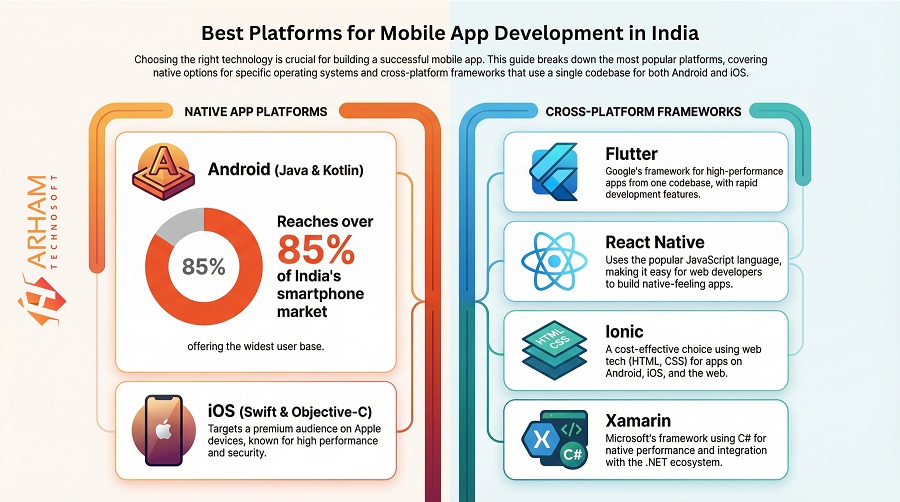
Android is the most widely used mobile operating system in India. With over 85% of the Indian smartphone market running on Android, it’s a powerful platform for building native mobile applications. Java has been the traditional programming language for Android app development for many years. However, in recent years, Kotlin has become the preferred language due to its modern features and seamless integration with Android Studio.
Key Features:
- Wide Market Reach: Android powers a large portion of smartphones in India, providing access to millions of users.
- Java & Kotlin Support: Java is an established language, while Kotlin offers more concise and readable code, making development easier.
- Rich Development Environment: Android Studio, the official IDE for Android, offers robust tools for development, testing, and debugging.
- Customizability: Developers can create highly customized apps that integrate deeply with Android devices.
Why Developers Love It:
- Access to a vast range of features and APIs.
- Large Android user base in India and globally.
- Open-source nature allows customization and innovation.
Challenges:
- Fragmentation: Android runs on many different devices with varying screen sizes, OS versions, and hardware specifications, which can complicate testing.
- Java has a steeper learning curve compared to Kotlin.
2. iOS (Swift & Objective-C)
Best For: Native iOS apps
Why It’s Great:
For businesses targeting users with Apple devices, iOS development is crucial. Apple’s operating system for iPhones and iPads is known for its performance, security, and user experience. Swift, introduced by Apple in 2014, has quickly become the preferred language for iOS development, replacing Objective-C due to its modern features, safety, and ease of use.
Key Features:
- High-Quality User Experience: iOS apps are known for their smooth performance, ease of use, and sleek design.
- Swift Programming Language: Swift is fast, efficient, and user-friendly, allowing developers to build robust applications.
- Xcode IDE: The integrated development environment offers powerful tools for designing, coding, and testing iOS apps.
- App Store Access: Apple’s App Store is a major platform for reaching a premium audience globally.
Why Developers Love It:
- Swift’s clean syntax makes it easier to write and maintain code.
- iOS apps generally have a higher revenue potential due to the affluent user base.
- iOS offers great integration with Apple services like iCloud, Apple Pay, and more.
Challenges:
- iOS development requires a Mac for using Xcode.
- The App Store has strict guidelines, which can make app approval more challenging.
3. Flutter
Best For: Cross-platform development (Android & iOS)
Why It’s Great:
Flutter, developed by Google, is one of the most popular cross-platform frameworks for mobile app development. It allows developers to write a single codebase and deploy the app on both Android and iOS platforms. With its fast development cycle and rich set of pre-designed widgets, Flutter makes it easy to create beautiful and high-performance apps for multiple platforms.
Key Features:
- Single Codebase: Write your app once and deploy it on both Android and iOS, saving time and resources.
- Hot Reload: Quickly see changes to the app’s code without having to restart it, speeding up the development process.
- Rich Set of Widgets: Flutter offers a wide range of customizable widgets that allow developers to create beautiful UIs.
- Strong Community & Google Support: As a Google-backed framework, Flutter is continuously updated and supported.
Why Developers Love It:
- Speedy development with the Hot Reload feature.
- Great for building apps with complex UI.
- Excellent performance due to Flutter’s native compilation.
Challenges:
- Limited third-party libraries compared to native development.
- Sometimes platform-specific features or integrations may be harder to implement.
4. React Native
Best For: Cross-platform development (Android & iOS)
Why It’s Great:
React Native, developed by Facebook, is another popular cross-platform framework that allows developers to create apps for both Android and iOS with a single codebase. It uses JavaScript, one of the most popular programming languages, and React, which is widely used for building web applications. React Native allows developers to use native components, giving apps a native look and feel.
Key Features:
- Single Codebase for Android and iOS: Write once, deploy everywhere.
- Native-Like Performance: React Native provides near-native performance and can access device features like the camera and GPS.
- Large Ecosystem: The JavaScript ecosystem is vast, offering a range of libraries and tools.
- Hot Reload: See changes instantly while developing, which speeds up the development process.
Why Developers Love It:
- Familiar JavaScript language is easy to learn for web developers.
- Great for building apps that feel native on both Android and iOS.
- The large React Native community ensures plenty of learning resources and third-party libraries.
Challenges:
- While React Native is close to native in performance, it might not be as efficient as fully native apps for very complex or resource-intensive apps.
- Debugging can be more complex compared to traditional development.
5. Ionic
Best For: Hybrid mobile app development (Android & iOS)
Why It’s Great:
Ionic is a hybrid app development framework that uses web technologies like HTML, CSS, and JavaScript to build mobile applications that run on multiple platforms. It’s built on top of Angular (a popular web framework), and developers can use it to create apps for Android, iOS, and the web with a single codebase.
Key Features:
- Single Codebase for Multiple Platforms: Build apps that run on Android, iOS, and the web using a single codebase.
- Pre-built UI Components: Ionic offers a rich library of pre-designed components to make app development faster.
- Cordova Integration: Access native device features (like the camera, GPS, etc.) through Apache Cordova.
- Web View Support: Ionic apps run inside a web view, meaning they are essentially web apps wrapped in a native container.
Why Developers Love It:
- Developers with web development experience can quickly learn and build mobile apps.
- It’s a cost-effective solution for building apps for multiple platforms.
- A large community and extensive documentation make it easy to find help.
Challenges:
- Performance might not be as fast as native apps, especially for complex, graphics-heavy apps.
- Hybrid apps can sometimes feel less polished compared to native apps.
Check out this blog on Native Apps vs Hybrid Apps
6. Xamarin
Best For: Cross-platform development (Android & iOS)
Why It’s Great:
Xamarin, owned by Microsoft, is a popular cross-platform framework for mobile app development. Xamarin allows developers to write C# code and use the .NET framework to create apps for Android, iOS, and Windows. Xamarin apps are compiled into native code, offering good performance and a native-like user experience.
Key Features:
- Shared Codebase: Write most of your app’s code once and share it across platforms.
- Native Performance: Xamarin compiles to native code, providing high performance on both Android and iOS.
- Integration with .NET: Leverage the powerful .NET framework and ecosystem for app development.
- Native User Interfaces: Xamarin allows you to create platform-specific UIs while sharing logic.
Why Developers Love It:
- C# and .NET are popular languages, making it easy for developers with experience in these technologies to get started.
- Offers native performance, unlike many other hybrid frameworks.
- Strong integration with Microsoft tools and cloud services.
Challenges:
- Xamarin can be more complex to set up compared to other frameworks like React Native or Flutter.
- The learning curve may be steep for developers not familiar with C# or .NET.
Conclusion
Choosing the right platform for mobile app development is key to ensuring your app’s success. In India, Android Studio (Java/Kotlin) is ideal for native Android apps, while Xcode (Swift/Objective-C) is best for iOS apps. For cross-platform development, Flutter and React Native allow you to create apps for both Android and iOS with a single codebase. If you’re building hybrid apps, Ionic and Xamarin are solid options. By evaluating your project’s needs, your team’s skills, and your target audience, you can select the platform that best fits your goals.